Moonrise and Moonset: A Silent Choreography in the Sky
We watch sunrises and sunsets en masse, but the moon puts on an equally impressive spectacle every day: moonrise and moonset. Because the moon is less bright and its rhythm more subtle, we notice these moments less. Yet, there’s a surprisingly complex story behind it. Time to unravel that mystery.
The Moon Doesn’t Rise – Just Like the Sun
Just like the sun, moonrise isn’t a matter of “the moon rising,” but of the Earth rotating. As the Earth rotates on its axis, your horizon shifts beneath the moon. This makes it appear as if the moon rises in the east and sets in the west.
But there’s an added twist: the moon also moves around the Earth. Consequently, its time of rising shifts by about 50 minutes each day. This makes moonrise much less predictable than sunrise.
Moonrise Depends On the Moon Phase
One of the most intriguing differences compared to the sun is that the moon phase determines when you see the moonrise.
- New moon: rises at about the same time as the sun—and is invisible.
- First quarter: rises around noon.
- Full moon: rises around sunset and sets around sunrise.
- Last quarter: rises around midnight.
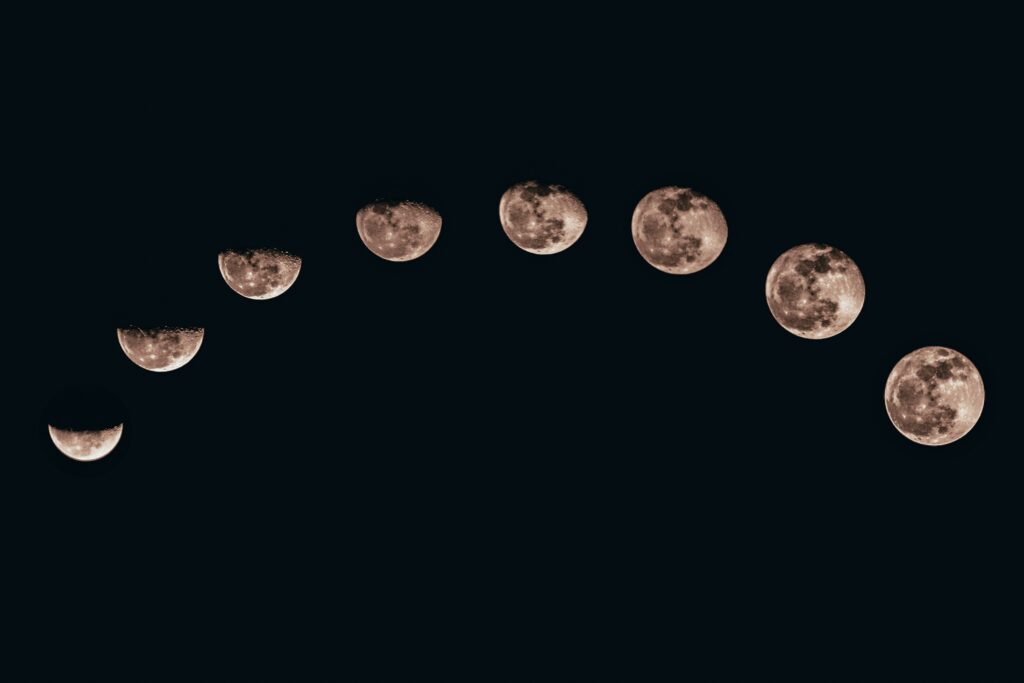
This explains why you sometimes see the moon in the morning, sometimes in the evening, and sometimes not at all.
Atmospheric Refraction: the Moon Appears Earlier Than You Think
Just like with the sun, the atmosphere causes you to see the moonrise slightly earlier than it is geometrically above the horizon. The air refracts the light, causing the moon to appear a few minutes “early.”
The effect is more subtle than with the sun, because the moon is less bright, but the principle is the same.
Why the Moon Sometimes Turns Red at Sunrise
Everyone is familiar with the blood-red moon that sometimes hangs low above the horizon. This is due to the same process that makes the sun red: Rayleigh scattering.
When the moon is low in the sky, its light travels through a thicker layer of atmosphere. The blue light is scattered, leaving the red light. This can cause the moon to appear
- coppery
- orange
- or even deep red
at sunrise or sunset.
During a lunar eclipse, this effect becomes extreme because the light is filtered by Earth’s atmosphere before reaching the moon.
The Moon Appears Larger at Sunrise – But That’s an Illusion
The famous “moon illusion” makes the moon appear gigantic at sunrise. Scientifically speaking, however, the moon’s size doesn’t change. It’s a psychological effect: when the moon is close to the horizon, we subconsciously compare it to trees, buildings, or hills. This makes it appear larger than when it’s high in the sky.
Our brain therefore plays a key role in this spectacle.
Moonrise Lasts Longer Than You Think
Because the moon is less intense than the sun, the transition is more subtle. The moon often appears as a soft glow that gradually intensifies. Clouds, humidity, and light pollution can completely transform the moonrise—from a dramatic appearance to a nearly invisible transition.
Why Moonrise Is Different Everywhere
Just like with the sun, location and conditions play a major role:
- Latitude: The closer you are to the poles, the more extreme the variation in moonrise times.
- Season: The moon follows an apparent path that changes throughout the year.
- Landscape: Mountains, oceans, and cities influence how and when you see the moon.
- Air quality: Pollution can enhance or obscure the color.
The moon is a master of variation: no two moonrises are identical.
Quiet, Elegant Moments
Moonrise and moonset are quiet, elegant moments that often escape our notice. Yet they tell a story of cosmic movement, optical illusions, and atmospheric magic. The moon follows its own rhythm—slower, more mysterious, and less predictable than the sun—making every appearance unique.
Those who take the time to watch its rise discover a celestial ritual every bit as enchanting as the sunrise.


