The Sun Goddess Amaterasu Ōmikami – Light, Power, and Spirituality in Japan
Within Japanese mythology and the Shinto faith, Amaterasu Ōmikami occupies a unique and central place. As the sun goddess, she is not only the bringer of light and life, but also the spiritual foundation of the Japanese imperial lineage and a symbol of order, harmony, and moral balance. For those interested in religion, culture, and history, her story offers a fascinating insight into how mythology and identity are intertwined in Japan.
In this blog post, we explore who Amaterasu is, where her stories originate, how she is revered, and why her influence is still felt in modern Japan today.
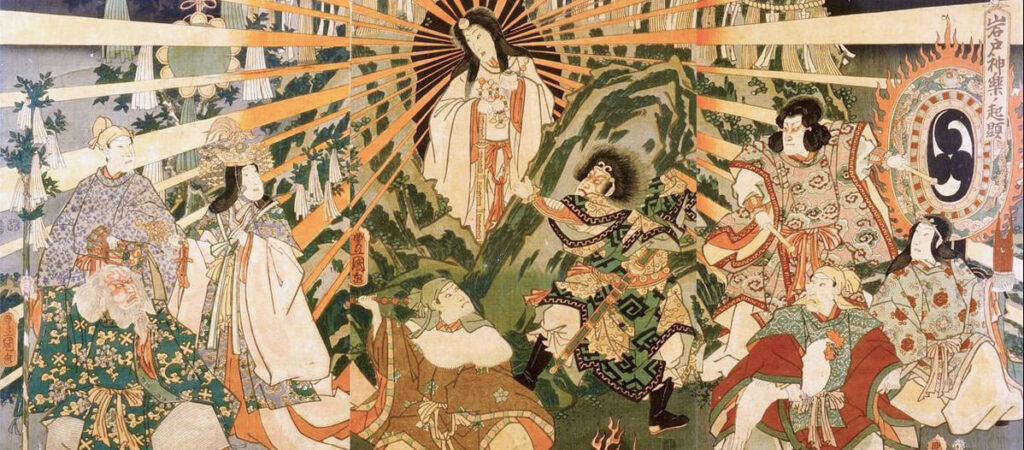
The Japanese Sun Goddess Amaterasu Ōmikami
The Origins of Amaterasu in Japanese Mythology
The most important sources on Amaterasu are found in two classical texts: the Kojiki (712) and the Nihon Shoki (720). These works form the foundation of Japanese mythology and describe the origins of the world, the kami (gods and spirits), and the imperial house.
According to these writings, Amaterasu was born from the left eye of the creator god Izanagi when he purified himself after a journey to the realm of the dead. Her brothers, Tsukuyomi (moon) and Susanoo (storm and sea), were born from his right eye and nose, respectively.
From the beginning, Amaterasu is portrayed as a deity of exceptional status. She is assigned the realm of heaven and becomes ruler of Takama-ga-hara, the heavenly domain of the kami. Her light symbolizes order, stability, and the survival of the world.
The Myth of the Cave: Light and Darkness
One of the best-known stories about Amaterasu is that of her retreat to the heavenly cave, Ama-no-Iwato. This story clearly illustrates the importance of her role in the cosmic balance.
After a violent and disrespectful outburst from her brother Susanoo, Amaterasu is deeply hurt. She locks herself in a cave and refuses to let her light shine any longer. The world is plunged into darkness: harvests fail, chaos increases, and the kami become alarmed.
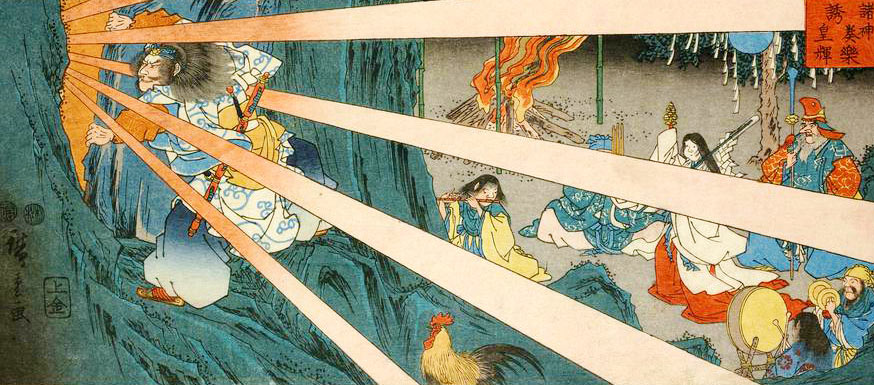
Amaterasu Omikami emerges from the cave
To lure her, the other gods organize a feast. The goddess Ame-no-Uzume performs an exuberant dance, causing laughter and merriment. When Amaterasu becomes curious and glances outside, the gods see their opportunity. They show her a mirror in which she sees her own radiant self. Fascinated, she steps outside, after which the cave is sealed shut.
This myth is often interpreted as a metaphor for depression, recovery, and the power of community. It emphasizes that even the most powerful deity is vulnerable, but also that harmony can be restored through cooperation.
Amaterasu and the Imperial Family
One of the most important aspects of Amaterasu’s role within the Shinto faith is her connection with the Japanese emperors. According to mythology, she sent her grandson, Ninigi-no-Mikoto, to earth to rule. His descendant later became the first emperor, Emperor Jimmu.
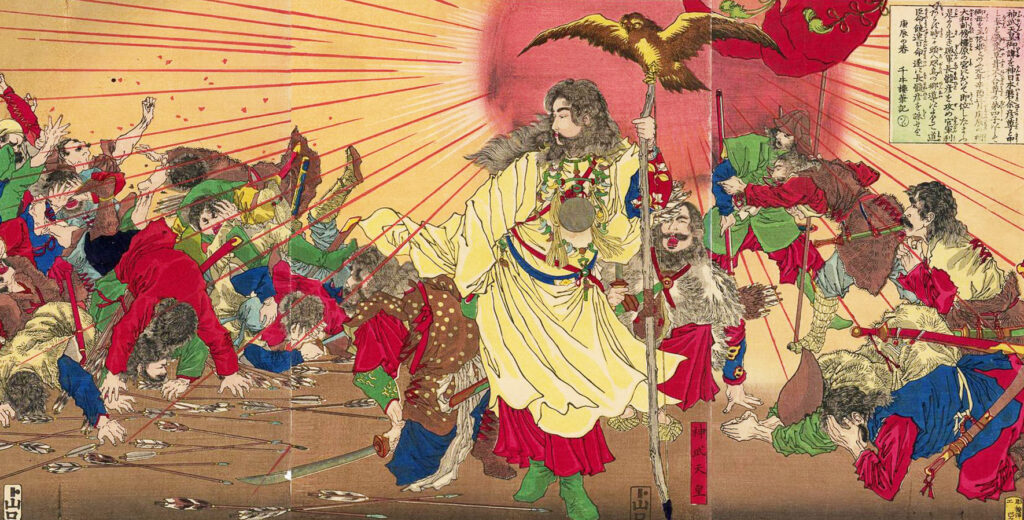
Emperor Jimmu
Therefore, the Japanese imperial family is considered descendants of the sun goddess. This divine lineage legitimized the emperor’s authority for centuries. Even in modern times, this symbolism remains important, although the emperor has no longer held divine status since World War II.
Yet, the spiritual connection with Amaterasu remains present in ceremonies, rituals, and court traditions.
The Ise Shrine: Spiritual Heart of Amaterasu
The most important shrine dedicated to Amaterasu is the Ise Grand Shrine. This shrine is considered the holiest Shinto shrine in Japan and is dedicated exclusively to her.
A unique aspect of Ise is that the complex is completely rebuilt every twenty years according to centuries-old traditions. This ritual, called Shikinen Sengū, symbolizes renewal, continuity, and respect for the past.
The shrine’s austere architecture reflects Shinto values: simplicity, harmony with nature, and spiritual purity. For many Japanese, a pilgrimage to Ise is a deeply religious experience, comparable to spiritual renewal.
Amaterasu within the Shinto Faith
Shinto is not a dogmatic religion with sacred books and fixed rules. Rather, it is a collection of rituals, traditions, and beliefs that revolve around the veneration of kami and a connection with nature.
Within this system, Amaterasu fulfills a special role:
- She symbolizes light, truth, and purity
- She represents cosmic order
- She serves as a moral compass
- She connects humanity, nature, and the divine world
Unlike many Western religious figures, Amaterasu is not omnipotent or infallible. She makes mistakes, gets hurt, and sometimes withdraws. It is precisely these human traits that make her relatable and approachable to believers.
Symbolism: Sun, Mirror and Sacred Treasures
Amaterasu is often associated with three sacred objects, the so-called Imperial Regalia:
- The Mirror (Yata no Kagami)
- The Sword (Kusanagi)
- The Jewel (Yasakani no Magatama)
The mirror, in particular, is closely associated with her. In the cave myth, this object plays a central role. It symbolizes self-reflection, honesty, and inner light.
Together, these treasures represent the moral qualities expected of a just ruler: wisdom, courage, and compassion.
Amaterasu in Modern Japanese Culture
Although Japan has become highly secularized, Amaterasu remains present in daily life and popular culture. Her influence is visible in:
- Manga and anime
- Literature and art
- Video games
- Festivals and rituals
She often appears as a powerful female archetype: independent, radiant, and morally strong. In a society where traditional and modern values converge, she serves as a bridge between the past and the present.
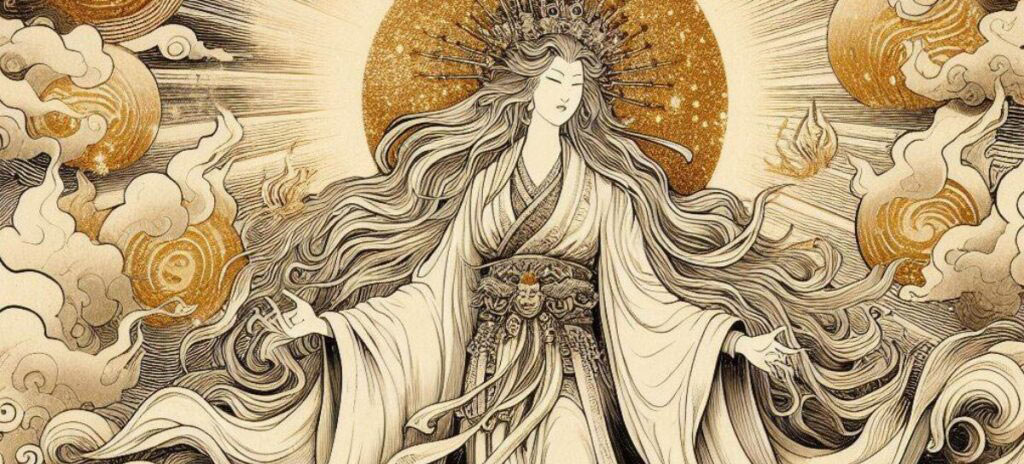
Amaterasu Omikami
Furthermore, Shinto rituals surrounding solstices, harvest festivals, and New Year’s are often indirectly linked to her, as a tribute to her life-giving power.
A Female Deity in a Patriarchal Context
It is striking that the highest Shinto deity is female. In many religious traditions, male supreme deities predominate, but in Japan, a sun goddess takes center stage.
This does not mean that Japanese society was historically equal to women. However, it does demonstrate that spiritual authority in mythology is not exclusively male. Amaterasu embodies leadership, wisdom, and power without losing her feminine identity.


